

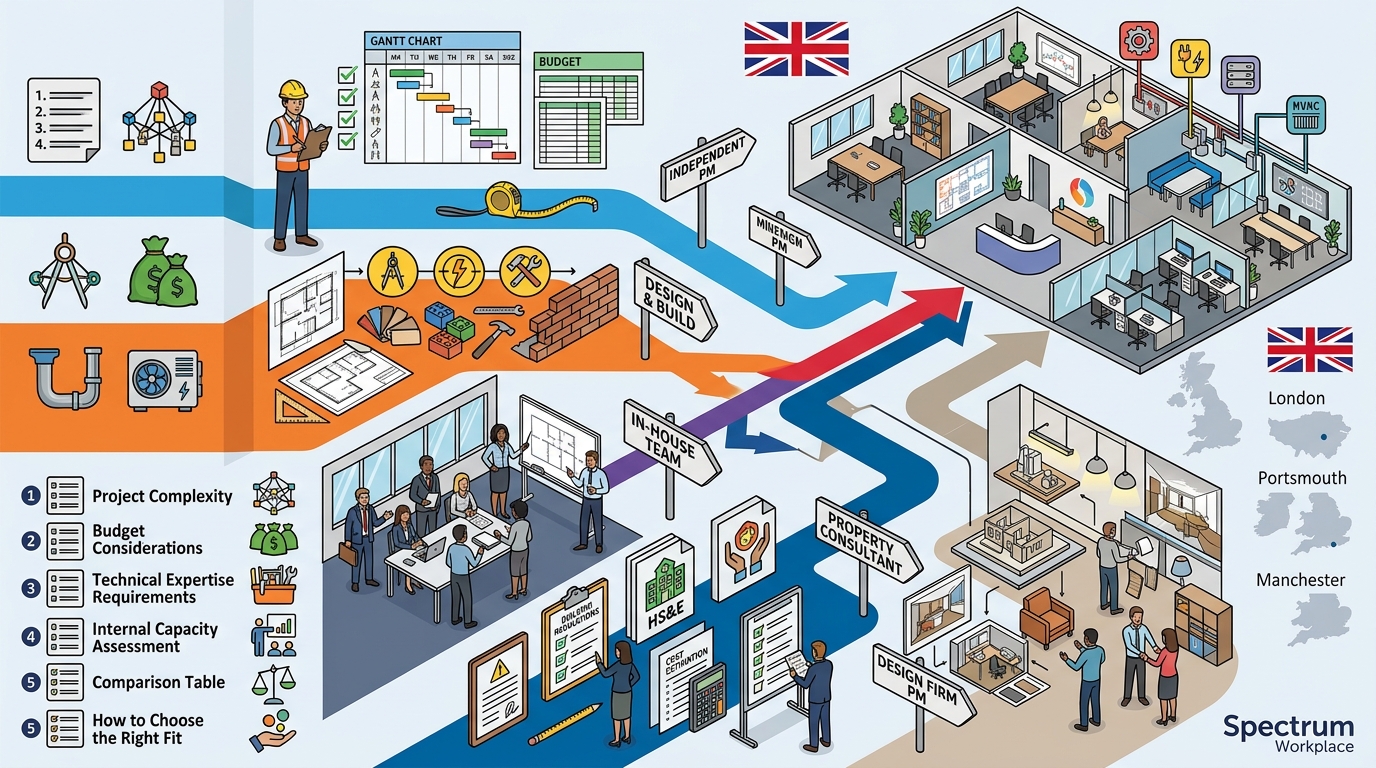
Any qualified professional or in-house team can project manage a UK office refurbishment, provided they hold the necessary statutory approvals and technical expertise. The right choice depends on your project's complexity, budget, and internal capacity. This guide examines the five primary routes available to UK organisations, from independent project managers to in-house teams, and explains how to select the best fit for your specific workplace transformation.
Independent Project Managers
Independent project managers are third-party specialists appointed to oversee the entire construction and fit-out process on behalf of the client. They act as the single point of contact, managing contractors, budgets, and timelines without being tied to a specific design or construction firm. This separation of duties can provide an objective view of project risks and costs, as their fee is typically not linked to the value of the construction works.
When to Use an Independent PM
This route is often chosen for complex, multi-tenant buildings or large-scale refurbishments where the client lacks internal construction expertise. Independent PMs bring specific knowledge of building regulations, fire safety compliance, and contractor procurement. They are particularly useful when the client wants to maintain strict control over the budget while outsourcing the day-to-day management of the site.
Pros and Cons
The primary advantage is objectivity. An independent PM has no vested interest in recommending specific materials or contractors, which can lead to cost savings. However, this route can sometimes lead to communication gaps if the PM does not have a strong relationship with the design team. It is crucial to ensure that the PM has a clear mandate and that the client remains involved in key decision-making stages to avoid misalignment with the original brief.
Architect and Interior Design Practices
Many UK organisations choose to appoint their design team to also handle project management. This integrated approach ensures that the design intent is preserved throughout the construction phase. Design-led project management is common in the workplace sector, where the aesthetic and functional quality of the space is a primary driver of the project's success.
Design-Led Delivery
When the design team manages the project, they can make real-time adjustments to the layout or finishes to resolve technical conflicts without losing the overall vision. This is particularly effective for office refurbishments that involve significant changes to spatial planning, such as creating new collaboration zones or updating acoustic environments. The design team understands the nuances of the brief and can advocate for the client's needs during contractor negotiations.
Integrated Service Models
Some practices, such as interior architecture and design firms, offer a full service that includes technical coordination and construction management. This model reduces the risk of information loss between design and delivery. By keeping the design and project management functions under one roof, organisations can benefit from a more streamlined process and a single point of accountability for the final outcome.
Building Surveyors
Building surveyors are technical specialists who focus on the physical fabric of the building and compliance with statutory regulations. While they are not always appointed as the lead project manager, they play a critical role in overseeing the technical aspects of a refurbishment. Their expertise is essential for ensuring that the project meets building regulations, fire safety standards, and accessibility requirements.
Technical Oversight and Compliance
Building surveyors manage the interface between the client and the local authority's building control department. They prepare the necessary applications and ensure that the works are inspected at the correct stages. For office refurbishments involving structural changes or alterations to escape routes, a building surveyor is often mandatory. They provide a layer of technical assurance that protects the client from legal and safety risks.
Role in Project Management
In some projects, a building surveyor may take on a broader project management role, particularly if the works are primarily technical in nature, such as a services upgrade or a structural repair. However, for a full workplace transformation that includes design and fit-out, they are usually part of the wider project team rather than the lead manager. Their role is to ensure that the technical delivery is robust and compliant, supporting the overall project manager in achieving the project goals.
In-House Management
In-house management involves using the client's own staff to project manage the refurbishment. This is a viable option for large organisations with established facilities management teams and significant internal resources. It allows the client to retain full control over the project and ensures that the workplace strategy is closely aligned with internal business objectives.
Resource and Expertise Requirements
Managing a refurbishment in-house requires a dedicated team with specific construction and project management skills. This includes knowledge of procurement, contract law, and building regulations. For most mid-sized businesses, the cost of hiring or training staff with these skills may outweigh the benefits of in-house management. It is also important to consider the time commitment required, as project management is a full-time role that can distract from core business activities.
When In-House Works Best
In-house management is most effective for organisations with a history of managing capital projects and a clear internal governance structure. It is also suitable for projects where the client has a strong relationship with a preferred contractor and wants to manage the relationship directly. However, for a first-time refurbishment or a complex multi-disciplinary project, the lack of specific construction expertise can lead to delays and cost overruns. It is often a hybrid approach where in-house staff manage the strategy and budget, while external specialists handle the technical delivery.
Professional Qualifications: RICS, CIOB, APM
When selecting a project manager, it is important to verify their professional qualifications and memberships. In the UK, the most recognised bodies are the Royal Institution of Chartered Surveyors (RICS), the Chartered Institute of Building (CIOB), and the Association for Project Management (APM). These qualifications provide a benchmark of competence, ethics, and professional standards.
Why Qualifications Matter
Membership of these bodies indicates that the individual or firm has met rigorous training and experience requirements. For example, RICS members are bound by a strict code of conduct and are required to maintain continuing professional development. This provides the client with confidence that the project manager is competent and accountable. It also ensures that the project is managed in accordance with industry best practices and legal requirements.
Choosing the Right Professional
Not all project managers hold these qualifications, but they are a strong indicator of professionalism. When evaluating potential project managers, ask about their specific memberships and any relevant accreditations. For instance, a firm with accreditations and standards such as ISO 9001 or ISO 14001 demonstrates a commitment to quality and environmental management. This is particularly important for sustainable office design projects where environmental performance is a key objective.
Comparison of Project Management Routes
| Route | Best For | Key Advantage | Key Risk |
|---|---|---|---|
| Independent PM | Complex, multi-tenant projects | Objectivity and cost control | Communication gaps with design team |
| Design Practice | Design-led transformations | Preservation of design intent | Potential conflict of interest in cost |
| Building Surveyor | Technical and compliance-heavy works | Statutory compliance and safety | Limited focus on design and user experience |
| In-House | Large organisations with FM teams | Full control and alignment with strategy | High resource requirement and expertise gap |
Key Takeaways
- Independent project managers provide objectivity and are ideal for complex projects where cost control is a priority.
- Design-led project management ensures that the aesthetic and functional vision is maintained throughout the construction phase.
- Building surveyors are essential for statutory compliance and technical oversight, particularly for structural or fire safety changes.
- In-house management is only viable for large organisations with dedicated facilities management teams and specific construction expertise.
- Professional qualifications such as RICS, CIOB, and APM are key indicators of competence and accountability in project management.
- The choice of project manager should align with the project's complexity, budget, and the client's internal capacity.
- Integrated service models can reduce risk by keeping design and delivery under one accountable partner.
- Always verify the professional memberships and accreditations of any project management firm before appointment.
Frequently Asked Questions
Can an architect project manage an office refurbishment?
Yes, many architect and interior design practices offer project management services. This integrated approach ensures that the design intent is preserved and that technical conflicts are resolved in a way that supports the overall vision. It is a common route for design-led workplace transformations.
What is the role of a building surveyor in a refurbishment?
A building surveyor focuses on the technical fabric of the building and compliance with building regulations. They manage the interface with building control and ensure that the works meet safety and accessibility standards. They are often part of the project team rather than the lead manager.
Is it better to use an independent project manager or a design team?
It depends on the project. Independent PMs offer objectivity and cost control, while design teams ensure the vision is maintained. For complex projects, a hybrid approach where an independent PM works closely with the design team may be the best option.
What qualifications should a project manager have?
Look for memberships of professional bodies such as RICS, CIOB, or APM. These qualifications indicate that the individual has met rigorous training and experience requirements and is bound by a code of conduct.
Can I project manage my own office refurbishment?
Yes, but it requires significant time and specific construction expertise. It is only recommended for large organisations with established facilities management teams. For most businesses, appointing a specialist project manager is a more efficient and lower-risk option.
How do I choose the right project manager for my project?
Consider the project's complexity, your internal capacity, and your budget. Evaluate potential project managers based on their experience with similar projects, their professional qualifications, and their approach to communication and risk management.
Conclusion
Selecting the right project manager is a critical decision that impacts the success of your office refurbishment. Whether you choose an independent project manager, a design-led practice, or an in-house team, the key is to align the management approach with your project's specific needs and your organisation's capacity. By understanding the roles and qualifications of the different professionals available, you can make an informed decision that minimises risk and maximises the value of your workplace investment. For organisations seeking a partner who can guide them through every stage of workplace change, to discuss how we can support your next project.