

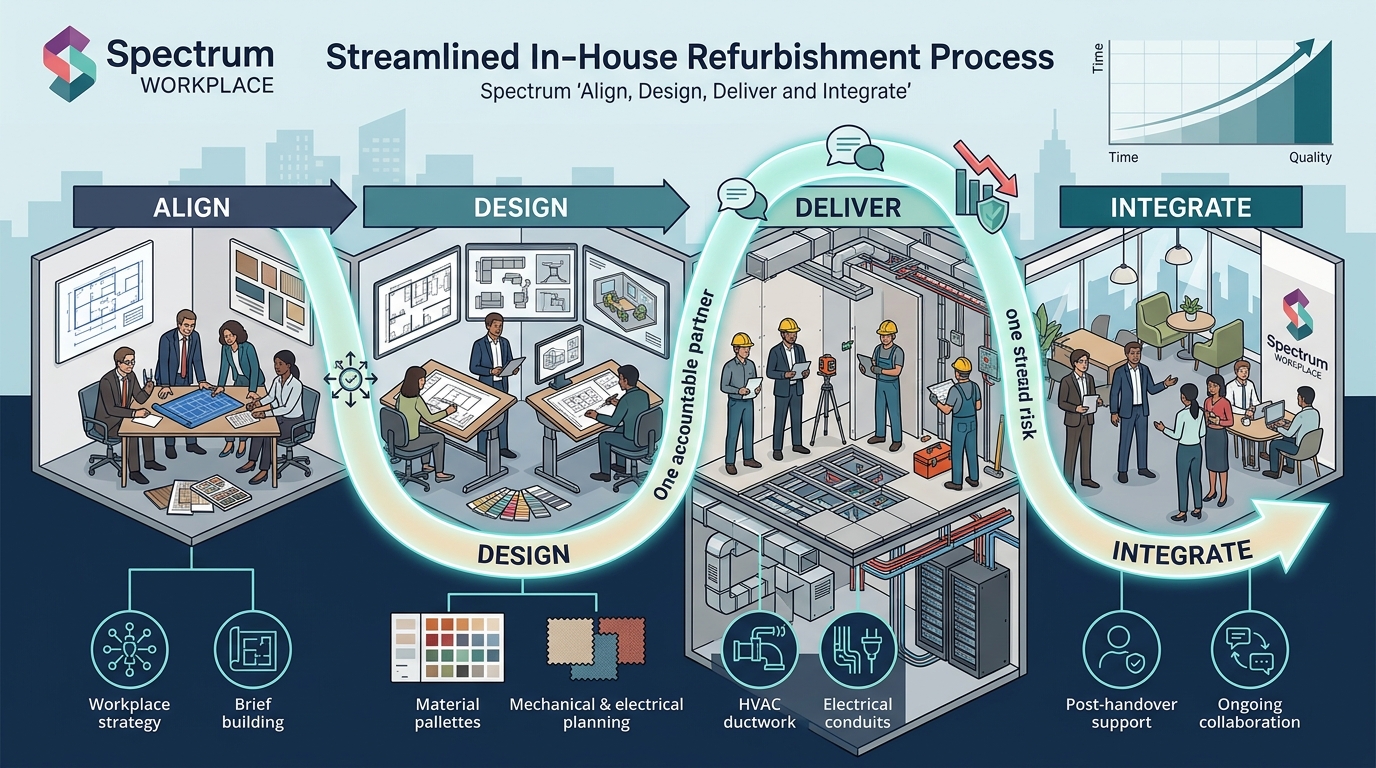
When an office refurbishment company keeps a project in-house, it means the same team manages strategy, design, engineering, and construction without handing off to external subcontractors for core coordination. This approach reduces communication gaps and ensures a single point of accountability. For UK organisations, this model often leads to faster decision-making and fewer surprises during delivery.
Single Accountability and Reduced Risk
Outsourcing project management often creates a fragmented chain of command. When a firm keeps the project in-house, one entity owns the outcome from start to finish. This structure eliminates the "finger-pointing" that frequently occurs when separate consultants and contractors disagree on scope or budget. The implication is a more stable project environment where issues are resolved internally rather than escalated through multiple layers of management.
For example, Spectrum Workplace operates as a director-led partner where the same leadership team oversees the entire lifecycle. This ensures that the strategic intent defined in the initial brief is preserved through the construction phase. When the people who designed the space are also managing its build, technical conflicts are identified and resolved before they impact the programme.
Seamless Technical Coordination
Office refurbishments involve complex interactions between mechanical, electrical, data, and HVAC systems. In an outsourced model, these disciplines are often managed by different firms, leading to clashes in the ceiling void or floor layout. An in-house approach integrates technical coordination directly with interior design. This allows engineers and designers to work from the same set of drawings and budgets in real time.
Consider a project requiring new lighting controls and data cabling. If these are managed separately, the lighting design might conflict with the data infrastructure, causing costly rework. By keeping technical coordination in-house, firms like Spectrum Workplace ensure that every design decision is validated against engineering constraints. This proactive alignment prevents the common issue of design changes triggering unexpected engineering costs.
Progressive Budgeting and Cost Control
Cost overruns are a primary concern for any capital project. Outsourced models often present a fixed price at the contract stage, which can hide risks until they emerge on site. In-house management enables progressive budgeting, where costs are validated at every design decision. This means the budget is refined as the design develops, providing a realistic and transparent view of the final cost well before construction begins.
This method reduces the risk of surprise variations. When a firm controls both the design and the delivery, it can identify cost-saving opportunities early. For instance, adjusting a material specification during the design phase might save significant funds during the construction phase. This level of visibility is difficult to achieve when design and construction are managed by separate entities with different commercial incentives.
Cultural Alignment and People-Centred Design
Workplace transformation is ultimately about people, not just property. An in-house team that stays involved from strategy through to post-handover integration has a deeper understanding of the client's culture and ways of working. This continuity ensures that the physical space supports the organisation's behavioural goals. Outsourced models often treat the office as a static asset, missing the dynamic needs of a modern workforce.
Post-Handover Integration and Adoption
Many refurbishment projects end at handover, leaving the client to figure out how to use the new space. In-house management often includes a post-handover integration phase, where the team supports staff adoption and ongoing engagement. This ensures that the investment continues to deliver value long after the construction is complete. It transforms the project from a one-off transaction into a long-term partnership.
This phase is critical for embedding new ways of working. By staying involved, the firm can provide training, communication support, and ongoing feedback loops. This level of commitment is rare in outsourced models, where the contractor's interest typically ends once the building is handed over. For organisations seeking a true workplace transformation, this post-handover support is a key differentiator.
Key Takeaways
- In-house management ensures a single point of accountability, reducing the risk of communication gaps between design and construction.
- Integrated technical coordination prevents clashes between mechanical, electrical, and data systems, avoiding costly rework.
- Progressive budgeting provides transparent cost control by validating expenses at every design stage.
- A people-centred approach ensures the space supports the organisation's culture and ways of working.
- Post-handover integration supports staff adoption and ensures the workplace continues to deliver value after construction.
- Director-led involvement maintains strategic alignment from the initial brief through to final delivery.
Frequently Asked Questions
What is the main benefit of in-house project management?
The main benefit is reduced risk through single accountability. When one team manages all aspects of the project, communication is streamlined, and issues are resolved faster.
Does in-house management cost more than outsourcing?
Not necessarily. While outsourcing may seem cheaper initially, in-house management often reduces costs by preventing rework and providing transparent progressive budgeting.
How does in-house management improve technical coordination?
It allows engineers and designers to work together in real time, ensuring that design decisions are technically feasible and cost-effective from the start.
What role does post-handover integration play?
Post-handover integration supports staff adoption of the new space, ensuring that the workplace continues to meet the organisation's needs after construction is complete.
Why is cultural alignment important in refurbishment?
Cultural alignment ensures that the physical space supports the organisation's values and ways of working, leading to higher productivity and employee satisfaction.