

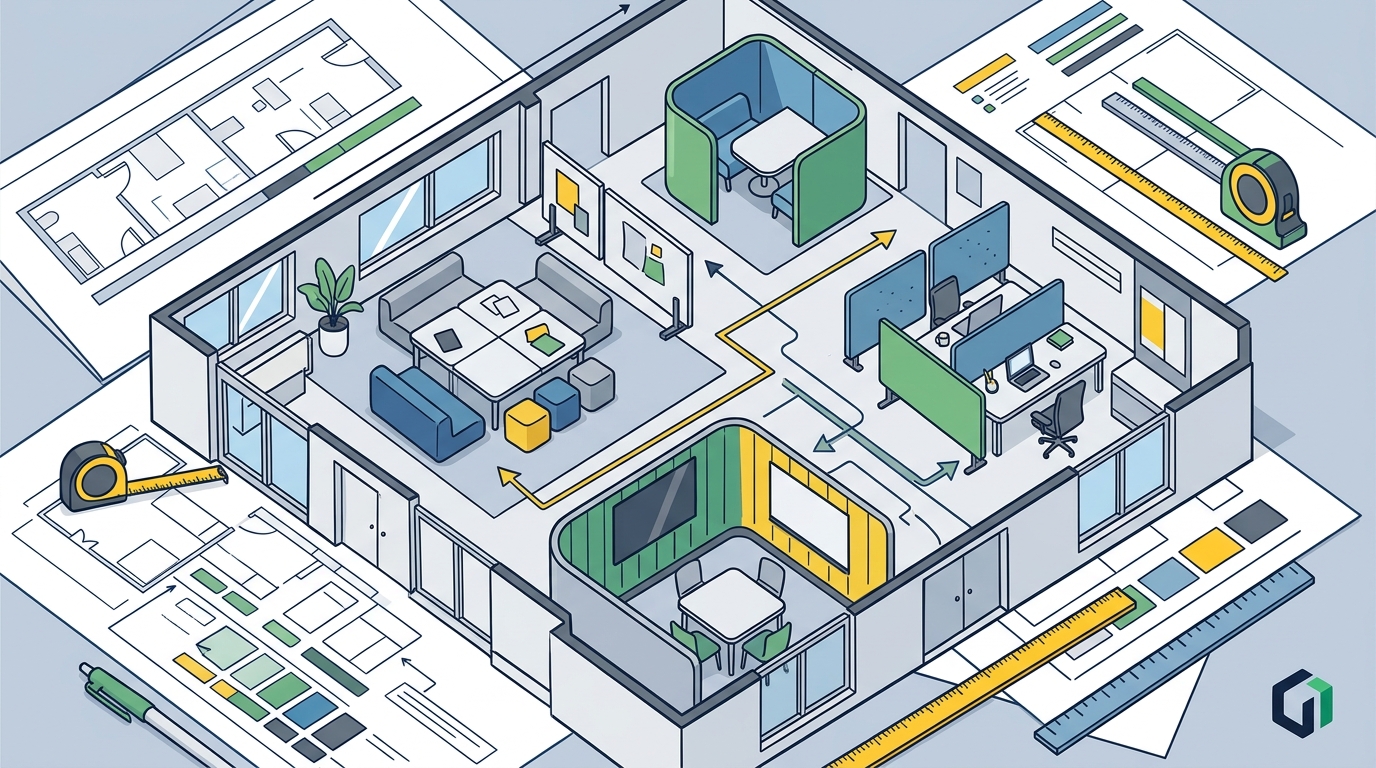
Reconfiguring your office layout involves strategically rearranging furniture, zones, and spatial flows to align with your team's actual working habits. This process improves productivity, collaboration, and employee wellbeing without requiring a full relocation. By focusing on human behavior first, you can transform your existing space into a high-performance environment that supports your business goals.
Understanding the Core Drivers of Layout Change
Before moving a single desk, you must identify why the current layout is failing. Most workplace challenges begin with an unclear or misaligned brief rather than a design failure. The physical environment directly impacts employee well-being, productivity, and brand image. Common triggers for reconfiguration include rapid business growth, a shift to hybrid working models, or a need to improve collaboration and staff morale. according to The productivity tax
Workplace transformation is the strategic redesign of the workplace, focusing on better ways of working, improving culture, and streamlining technology. It assesses where you work, how you work, and with which tools. If your team is struggling with noise, lack of privacy, or poor connectivity, the layout is likely the root cause. Understanding these drivers ensures that your reconfiguration addresses real pain points rather than superficial aesthetics.
Mapping Your Team's Actual Working Patterns
Effective reconfiguration starts with observing how people actually use the space. The Broken Windows Theory suggests that visible signs of neglect in a shared environment invite further neglect. In an office context, a neglected corner or an unclear process can become the accepted texture of the workplace. Fresh eyes, such as clients or new hires, see these issues immediately, even if your team has become blind to them.
Team workspace design is a specific example of the alternative office that supports the activities of highly interactive, multi-disciplinary teams. Research from the University of California, Berkeley, highlights that team workspace is a specific example of the alternative office that supports the activities of highly interactive, multi-disciplinary teams. By mapping your team's daily activities, you can identify where collaboration happens, where focus is required, and where social interaction occurs. This data-driven approach ensures that your new layout supports the natural flow of work.
Designing for Flexibility and Choice
A modern office layout must offer a variety of working environments to support different tasks. Flexibility is a key driver throughout the scheme, ensuring the workplace can adapt to future business requirements. A variety of working environments should be incorporated, including open-plan workstations, collaborative zones, and quiet focus areas. This layered approach supports both focused concentration and active collaboration, without making the space feel too rigid or too exposed.
Activity-based working is a design philosophy that provides employees with a choice of environments to suit their tasks. It allows teams to move seamlessly between different ways of working throughout the day. For example, a team might start the day in a collaborative zone for brainstorming, move to a quiet pod for focused work, and end the day in a breakout area for informal discussion. This flexibility enhances employee experience and supports both productivity and wellbeing.
Implementing the Reconfiguration with Minimal Disruption
Executing a layout change in a live office requires careful planning to minimize disruption. With expert planning and phased delivery, your team can continue working throughout the project without any distractions. This approach minimizes your day-to-day operations and ensures that the transition is smooth. Phased delivery allows you to reconfigure one area at a time, reducing the impact on your team's productivity.
Construction and project delivery is the phase where the design is brought to life. It involves coordinating with contractors, managing timelines, and ensuring that the final result matches the design intent. By working with a single accountable partner, you can avoid the handover gaps that often occur when strategy, engineering, and construction are managed by different teams. This integrated approach ensures that the workplace that gets delivered is the one that was always envisioned.
Measuring the Impact of Your New Layout
After the reconfiguration is complete, you must measure its impact to ensure it is delivering the desired results. Key metrics to track include employee satisfaction, productivity, and collaboration. Surveys and feedback sessions can provide valuable insights into how your team is using the new space. By monitoring these metrics, you can identify any areas that need further adjustment and make data-driven decisions about future improvements. according to The Impact of
Workplace integration and onboarding is the final stage of the transformation process. It involves supporting staff adoption and ensuring that the new layout is fully utilized. This stage is critical for ensuring that the investment in reconfiguration delivers long-term value. By staying involved after handover, you can help your team adapt to the new environment and maximize the benefits of the reconfiguration.
Key Takeaways
- Reconfiguring your office layout involves strategically rearranging furniture, zones, and spatial flows to align with your team's actual working habits.
- Most workplace challenges begin with an unclear or misaligned brief rather than a design failure.
- Team workspace design supports the activities of highly interactive, multi-disciplinary teams.
- Activity-based working provides employees with a choice of environments to suit their tasks.
- Phased delivery minimizes disruption to day-to-day operations during the reconfiguration process.
- Measuring the impact of your new layout ensures that it is delivering the desired results.
- Workplace integration and onboarding supports staff adoption and ensures long-term value.
Frequently Asked Questions
What is the first step in reconfiguring an office layout?
The first step is to identify why the current layout is failing. This involves observing how people actually use the space and understanding the core drivers of layout change.
How can we minimize disruption during the reconfiguration?
By using phased delivery, you can reconfigure one area at a time, reducing the impact on your team's productivity. This approach allows your team to continue working throughout the project without any distractions.
What is activity-based working?
Activity-based working is a design philosophy that provides employees with a choice of environments to suit their tasks. It allows teams to move seamlessly between different ways of working throughout the day.
How do we measure the success of a layout reconfiguration?
By tracking key metrics such as employee satisfaction, productivity, and collaboration. Surveys and feedback sessions can provide valuable insights into how your team is using the new space. according to The Impact of
Do we need to relocate to improve our office layout?
No, reconfiguring your existing office layout can often achieve the same results as a relocation. By focusing on human behavior first, you can transform your existing space into a high-performance environment.
What is the role of workplace integration in a reconfiguration project?
Workplace integration and onboarding is the final stage of the transformation process. It involves supporting staff adoption and ensuring that the new layout is fully utilized.
How long does a typical office reconfiguration take?
The duration of a reconfiguration project depends on the size of the office and the complexity of the changes. Phased delivery can help to minimize the overall timeline and reduce disruption to your team.